

HISTORY OF THE COLLECTIVE AWAKENING OF THE EARTH BRAIN
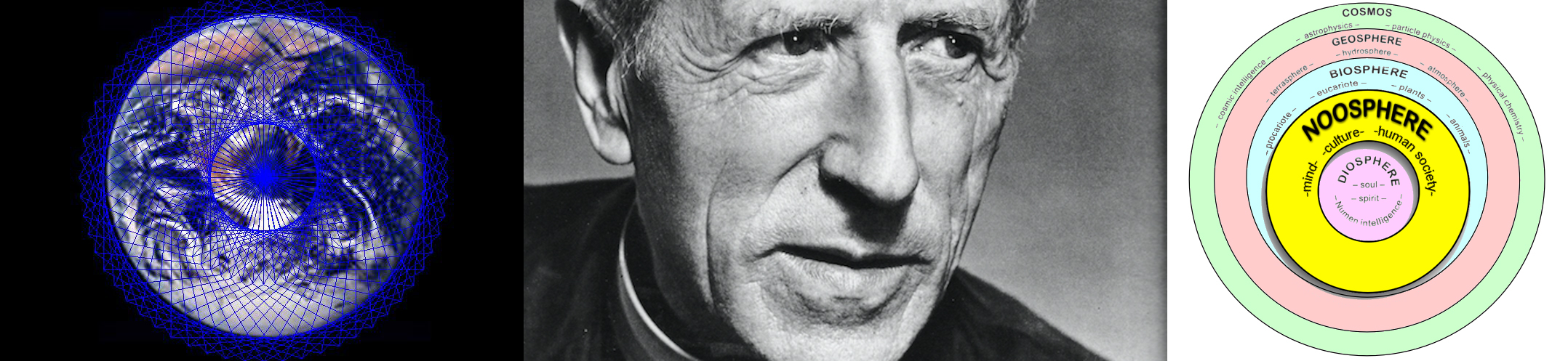
Is evolution advancing toward the awakening of the planetary mind? After the biosphere, does the noosphere emerge? Teilhard de Chardin, Vladimir Vernadsky, José Argüelles, and Terence McKenna conspire with the mind of Gaia to activate a global consciousness that includes every living being as a node within a self-reflective, interconnected whole.
The only true and natural human union is the spirit of the Earth.
Pierre Teilhard de Chardin
The noosphere is the greatest utopia in the history of our planet. And although this dimension promised by material, mental, and spiritual evolution cannot exist in physical space as we know it, the ether (or hyperspace) with its golden gardens of information, its rivers of light, and its total and instantaneous interconnection is sufficient to keep this dream of collective lucidity alive.
The word “noosphere” comes from the Greek nous (mind) and sphaira (sphere). The divine Plato uses the word nous in the Dialogue of Philebus, and Socrates says: “All philosophers agree—and thus exalt themselves—that the mind (nous) reigns over heaven and earth.” In Gnostic philosophy, the nous will sometimes be seen as the father of the Logos, as the first Aeon, whose lineage gives birth to Christ and Sophia; at other times the nous will be identified with Christ himself, something that will be taken up by Pierre Teilhard de Chardin, the Jesuit priest who created the concept, together with the geochemist Vladimir Vernadsky, of the “noosphere”.
“We must broaden our approach to encompass the formation taking place before our eyes […] of a particular biological entity that has never existed on Earth—the growth, outside and above the biosphere, of a new planetary layer, an envelope of thinking substance, to which, for convenience and symmetry, I have given the name of the Noosphere,” Pierre Teilhard de Chardin, The Future of Man.
The evolution of a mystical idea—the mind as something existing beyond the brain, permeating the universe and fertilizing it with imagination, the central attribute of divinity—unfolds through biology and is reinforced by including the processes of matter. The greatest influence on Teilhard’s noospheric thought was Henri Bergson and his concept of creative evolution, which opposes Descartes’ dualism and conceives of evolution as a constant vital force (elan vital) that animates matter and fundamentally connects the body and mind (the essential role of the universe is “to be a machine for creating gods,” Bergson said).
The other father of the noosphere, who was also the father of geochemistry, Vladimir Vernadsky, conceives of the noosphere as the third stage in the development of the Earth, after the geosphere (inanimate matter) and the biosphere. Vernadsky sees the emergence of consciousness as something that must have been implicit in the Earth’s evolution from the beginning. A current that goes beyond our individual will: “In the great historical tragedy in which we live, we have elementally chosen the right path toward the noosphere. I say elementally, since the entire history of humanity proceeds in this direction […], humanity as a whole is becoming a powerful geological force. The mind of humanity and its work are faced with the problem of reconstructing the biosphere in the interest of conceiving humanity freely as a single entity.
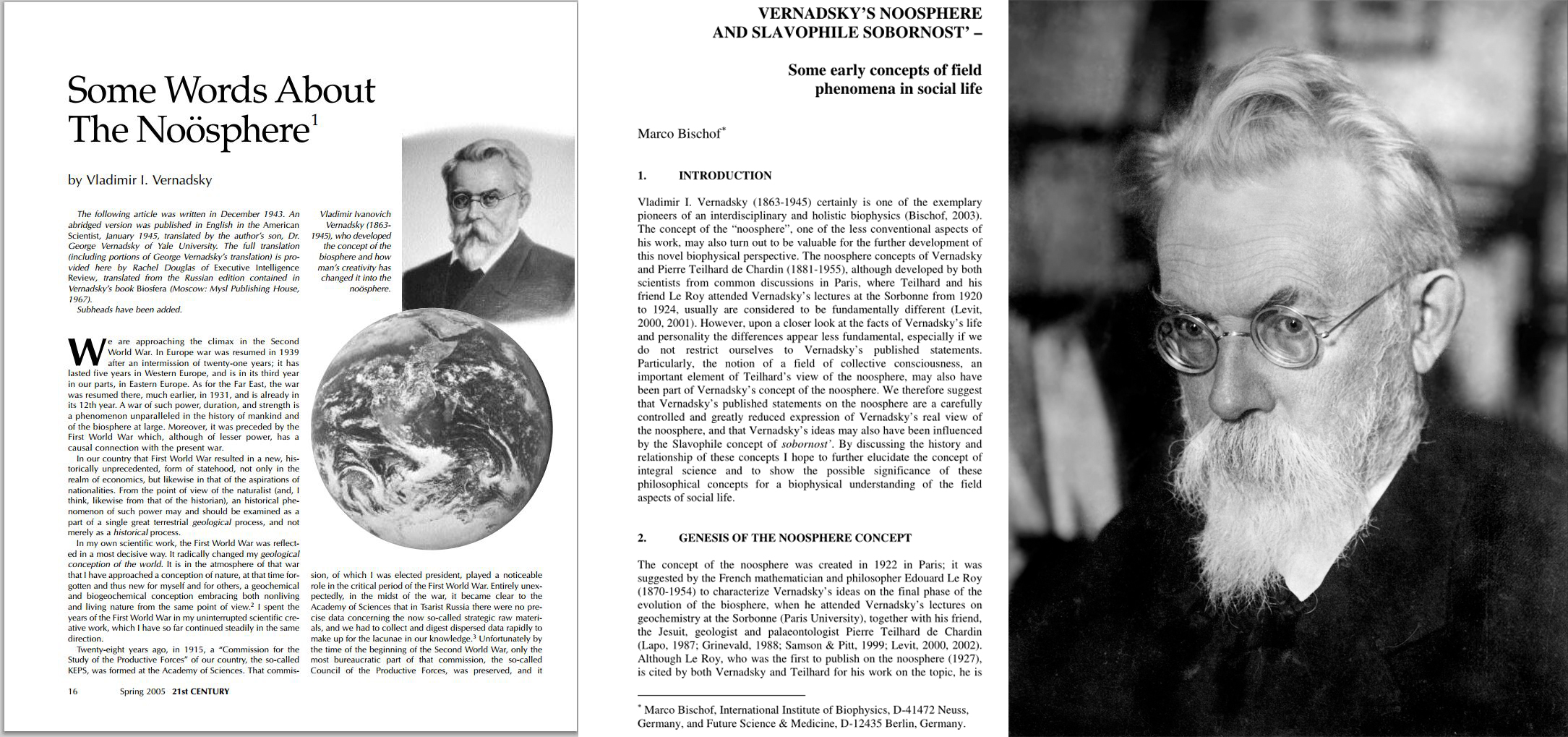
The key here is the conception of humanity as a geological force, a force of the Earth, embedded in the evolutionary river of the planet. That is, the possibility of being used by the Earth to achieve self-awareness. A project of the planetary mind, of what James Lovelock called Gaia, the superorganism that composes the biosphere and transcends the sum of its parts, to sublimate itself and perhaps become, like a supernal alchemist, a gigantic philosopher’s stone where matter and spirit are indistinguishable and duality no longer exists. Perhaps a project that could be aborted if we don’t take it to the critical cosmic point of mass awakening.
“The planet is a kind of organized intelligence. It’s very different from us. It’s had about 5 billion years to create a slow-moving mind made of oceans, rivers, forests, and glaciers. It’s becoming aware of us, and we are becoming aware of it, strangely enough.” Two more unlikely partners in a relationship can hardly be imagined: the technological ape and the dreaming planet,” Terence McKenna.
We began this article by saying that the noosphere is a utopia because it is the seed idea of an idyllic collectivity that fundamentally seeks to materialize a dream, in reality, to etherealize all minds into one mind, a great radiant layer of interpenetrating consciousness. As such, it goes beyond our conception of material space: it connects with the conception of a spiritual space or an information space similar to what is known in Sanskrit as Akasha, a word that means ether, but which has also been understood by theosophy as an immaterial library or universal memory bank, the Akashic Records. In this worldview, all of space—the ether—is itself a holographic plethora of information. In each particle of ether, we hold all the information of the universe, as if the entire Internet were contained in each bit (quantum theory has called this the q-bit, and systems theory the holon). The noosphere is an avatar of Akasha, in which the possibility of telepathically connecting to all the information of the planet and each of the organisms that compose it dawns, receiving on the mystical plane the galvanization “of the truth that will set you free.”
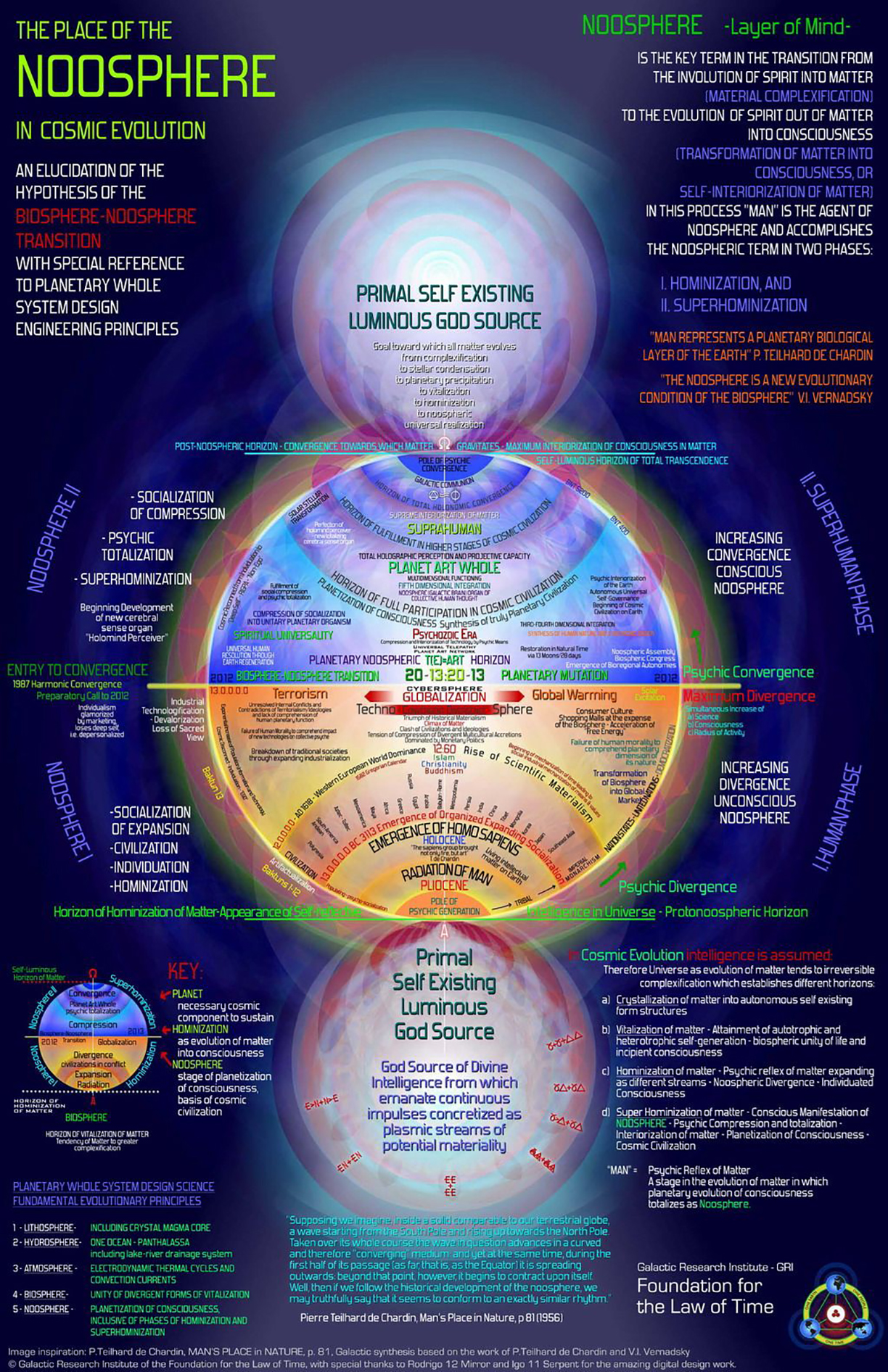
It is a utopia because the people who have embodied the mobilization of the noosphere are great optimists who see evolution as a vehicle of intelligence that cannot cease, an overwhelming organic machine that magnetizes itself to the end of history. Both Teilhard and Vernadsky, and the followers of this idea (Mckenna, José Arguelles, Ken Wilber), are, at heart, utopians who, perhaps because of their luminous ability to penetrate the noosphere itself and obtain the epiphany of its consciousness, have enormous confidence in their ineluctable path.
But we have the case of James Lovelock, who popularized the notion that the Earth is a self-regulating living being with his Gaia theory. In his most recent work, he argues that due to the fate of our actions and their effect on climate change, by the end of this century only 150 million human beings will exist on the face of the planet. Will the noosphere be solely theirs, the chosen ones, concretizing the paradise of the mind but destroying the democratic spirit of its origin? Or will they have to reboot the system and undergo a new evolutionary process to ingratiate themselves with the planet’s native intelligence?
But let us continue along the optimal path of utopia, channeling crystallization, perhaps participating in the wireless weaving of this great planetary mandala, this necklace of Indra’s pearls in which each pearl reflects not only all the other pearls but all the reflections that occur between them (where the pearls are the thoughts).
Erik Davis, in his book Techgnosis, posits the thesis that technology hides within its hardware, in its unconscious, the desire to materialize the spirit. Davis says of Teilhard’s noosphere:
Teilhard had no doubt that this transference (the mechanism of evolution transferred to the social and conscious level) was for the good, because in the long run human activity would awaken the planet itself. From its beginnings, the Jesuit believed that the human mind wove itself into a collective matrix of communication and interaction, an ethereal web of consciousness that not only linked human individuals but was destined to cover the entire biosphere like the skin of an onion. Teilhard called this cerebral crown of creation the “noosphere,” a collective psychic entity that arose from the same organic and symbiotic impulse toward unity and complexity that initially led free chemical elements to unite in molecules and cells.
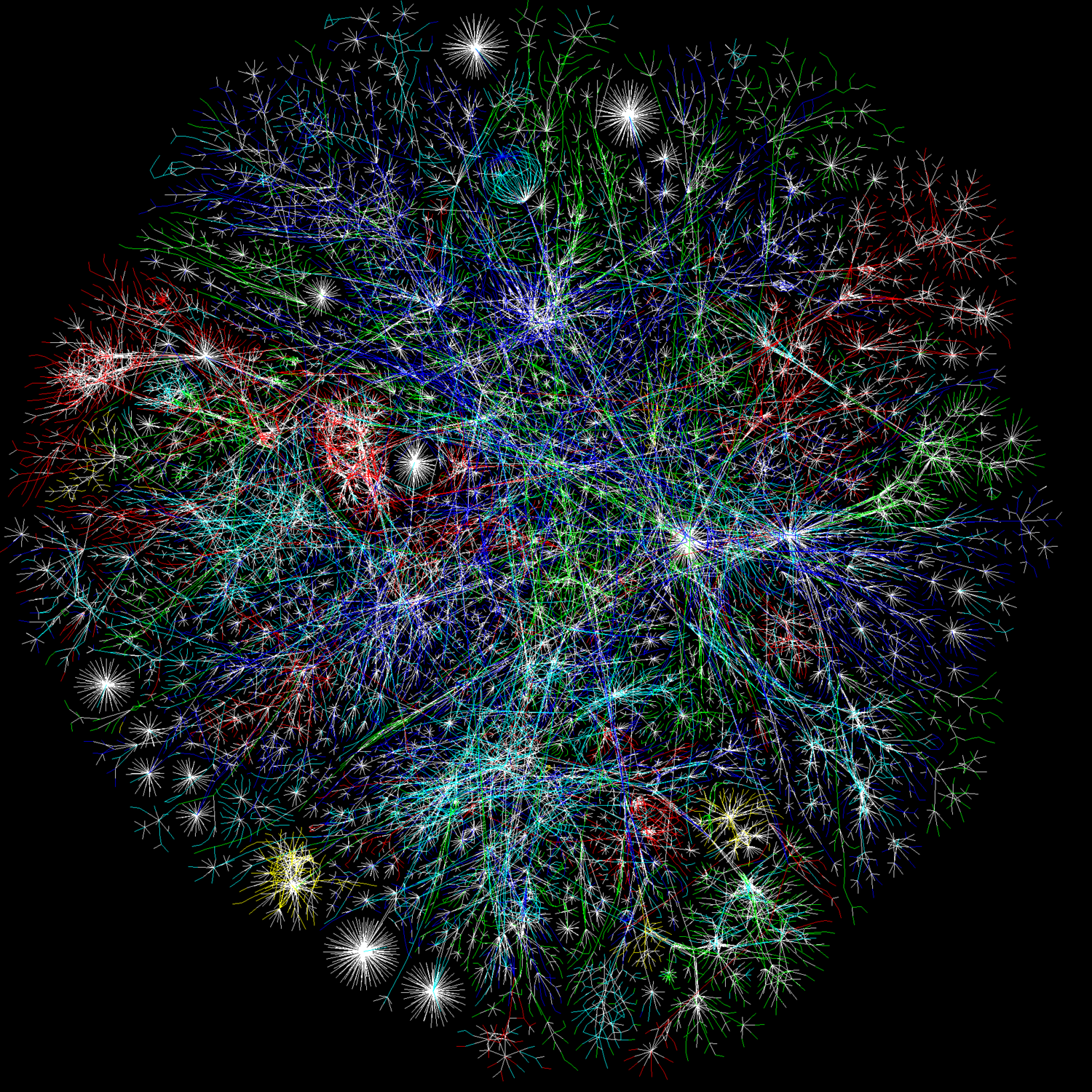
In the noosphere, these allied units are cultural bits, memes, language, imagination, thoughts, and possibly human lives in a holographic crucible of quantumly intertwined dreams and emotions. The influence of Teilhard’s noosphere was fundamental in the early days of the Internet. The founders and editors of Wired magazine, Kevin Kelley, Louis Rosseto, and John Perry Barlow, took Teilhard’s ideas and reprocessed them within information technologies, transforming the pristine vision of the Internet into a neo-neurobiological space, where the Net is the materialization—beyond metaphor—of neural connections (and information is the spirit that is transmitted electrophantasmagorically, announcing, like the archangel, the arrival of a new era).
Perry Barlow wrote in Wired: “The point of all evolution up to this point is the creation of a collective organization of Mind.” Rosetto said in an interview (quoted by Erik Davis): “What seems to be evolving is a global consciousness formed from the discussions, negotiations, and feelings that are being shared by individuals connected to networks through brain-based applications like computers. The more minds that connect, the more powerful the consciousness will be. To me, this is the real digital revolution—not computers, not networks, but brains connecting to brains.”
Seeing the ideas of Teilhard de Chardin reflected in technology and the widespread optimism that intelligence (as in the case of Tim Leary) conquers space and makes us emerge from the dust as creators and controllers of our reality, gives rise to transhumanism and extropianism, which postulate the possibility of escaping the prison of the body and death into a kind of purely digital noosphere in which our immortal consciousnesses, augmented by interaction with machines, are fully connected and can access to artificial paradises of design. This is the path where technology replaces magic and machines replace bodies as vehicles of the spirit (which becomes information and electric light).
But on the other hand, we have Ken Wilber, who conceives of the new stage in our history as the “Noocene,” an era in which intelligence takes control of society, whose success will be determined by “how we manage to manage and adapt to the immense capacity for knowledge we have created.”
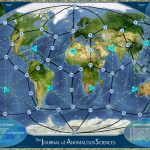
The Global Consciousness Project (GCP), the refined project from Princeton University, measures the moments in which human consciousness synchronizes and becomes coherent, affecting the behavior of random systems. That is, moments in which global consciousness affects matter. By measuring events such as the attack on the Twin Towers, the election of Obama, or collective meditations, Princeton scientists (led by the maverick Roger Nelson) have noticed that the synchronization of millions of people affects these energy-generating systems.
DREAMING THE DIMENSION OF RANDOM SIGHT
Monte Carlo and Random Walks flow through the synapses of the meditating monk,
Brownian Motion the master says,
you’ll not find it in this dimension even if you use your head,
He picked up a stick and threw it into the air,
and said now that’s a perfect motion in which you can declare.
Find not my son the trajectory of the cannon ball’s flight,
the sea is the mother the wave is the light,
You think you are separate and that’s your fate,
if you could only see from where I’m sitting there would be no debate,
Stochastic processes, multidimensional parabolic states,
I don’t think so, you’re way too late,
Consciousness continually searching for itself in every delight,
so how might I find you on this continuous flight?
Look not at the structure or the zero point wave,
where you’ll find me is whispering in a EGG.
— Tom Sawyer, Santa Rosa, CA (Global Consciousness Project)