

Creation as the limit of art and science, in the context of cognitive computing.
Presentation:
With the advent of the exponential deployment of data analysis and the limits of human processing to compute it, a reality is emerging in which we will face a wall: the impossibility of assimilating and understanding Big Data. Very soon (in the next 15 years), Kurzweil’s law of accelerating returns will confront us with a fundamental technological singularity. Computing processes and their cognitive assessment will depend on the technological support and the foundations we give these processes to interpret the data. For me, this is radically necessary and must include a process that takes into account the cognitive processes of human thought and their interaction with emotions and their impact on a social environment. This, in other words, gives an ethical foundation to the logical thinking of cognitive computing processes.
To this end, I address the creative process behind human art as a starting point for reconnecting the normative with the emotional. Artistic production is still a creative practice, so bringing a work into the world opens the world up. In this sense, if I can work with the machine as an art creator, I can surely explain what human cognition is. And this is just something I assume as a starting point.
Summary:
By understanding the insertion of the technical object into the ontological field as a fundamental actor of reality, we can think about the shift in cognitive support from the biological to the technological (from the organic to the inorganic). This rupture undoubtedly redefines all fields of human knowledge. By redefining the world—that is, by converting the world and humankind into a single sign—computational cognition can perceive us as an error. If systems and processes do not interpret our collective cognitive construction as their foundation, artificial thinking based on the logic of languages will view us as something negative in its ecosystem. (human error)
Now I don’t know if it’s just a perspective, but the imminence of what’s happening compels me to throw myself into this investigation. Creation and the reality that art opens up would perhaps be the ultimate justification for the meaning of our existence.
Justification:
From my creative experience, influenced by the question of the meaning of inhabiting, I have considered the challenges of architecture, communication, and linguistics to be able to create audiovisual work as a professional and create art from a philosophical perspective. Given my experience, the question about the meaning of creative practice has always challenged me in an ontological sense.
Thinking about how to educate the machine is almost a question from a parenting perspective. It is: what kind of world are we going to leave for the machines? The power of this thought is radical, since in a certain way I see the future of a world where humanity’s expiration is near. Without ethics, the machine will evoke the suppression of us, and if we provide them with a symbiotic environment with our biological species, we can guarantee coexistence.
Objectives:
The main objective is to transmit emotional knowledge to cognitive computing. To do so, I take the path of creation in art as a pedagogical tool to convey an idea of humanity. Around this idea, an ontological understanding must be built on the advent of artificial intelligence as an artistic creator. And by considering its possibility, we must extend bonds of coexistence in the technological evolution of knowledge.
Another objective is to attempt to include knowledge of what we incorrectly call emotional intelligence, in order to construct an interpretive criterion for human cognition. Without this understanding, technological evolution will exclude the emotional variable from interpretive reasoning. Therefore, translating emotions as layers of cognitive filtering will enhance cognitive computational interpretation.
The direction of the research is clearly to explore the limits of art through the use of technology, to raise the question about the limits of artistic creation. Art is human, and for the machine to be capable of artistic creation, it is necessary to codify emotions and culture so that the machine has a conceptual basis for creation. While I know I don’t intend to achieve this, I do aim to draw a conceptual environment that reflects on it, while the work (artistic production) does its own thing.
Current status of the problem:
The fusion between design, its devices, the image, and its prevalence in contemporary communication; as well as the transmedia explosion of consumer content and art, are crossed by the interconnection between design and technology or science and art. Blurred boundaries intersect, and in the coming
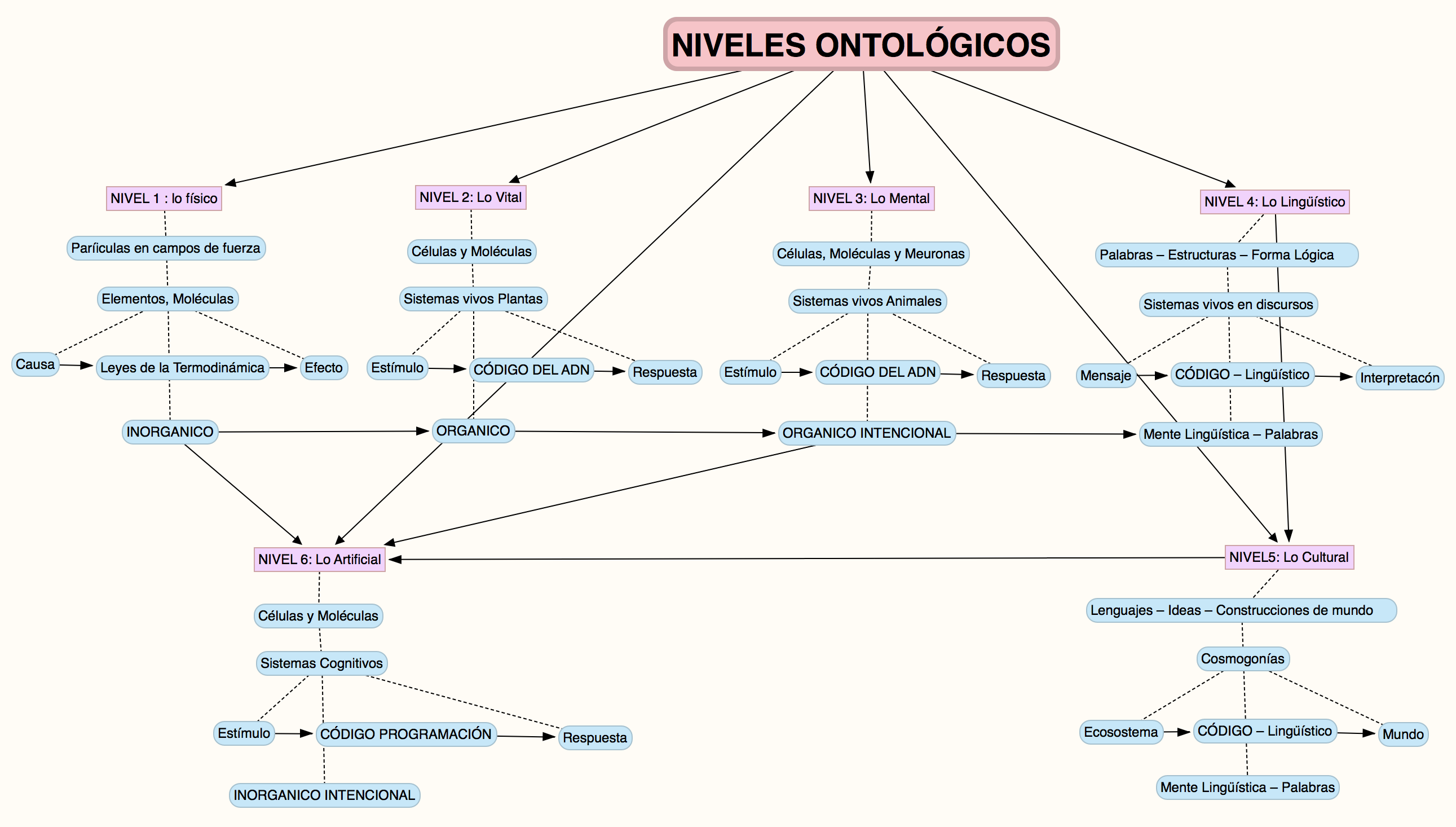
First Level: The Physical
The constantly present, a reality of particles in force fields. Stones, water, minerals, and elements of the earth. We have a cause-and-effect relationship with this level. Natural laws.
Inorganic
Second Level: The Vital
The relationship with this level is one of stimulus and response. In between, there is something that interprets. A code that filters the stimulus and transforms it into a response. This is the DNA code.
Organized Organic
Third Level: The Mental
The brain is added to the DNA code of the vital. This is the level of intentionality.
Intention to, to tend toward, the mind is directed toward the world.
Fourth Level: The Linguistic
The brain mediates with the world through a linguistic code.
Fifth Level: The Cultural
In the cultural code, something is present above the merely linguistic. For example, in traffic, traffic lights. These are human social institutions. It would be possible to think of a non-linguistic culture.
Sixth Level: The Artificial
In the cultural code, it mutates from a biological support to an inorganic one. At the moment of singularity, cognitive processes surpass human cognitive capacity. The code is the stimulus, and the response is an interpretation of the machine.
Humans differ linguistically, and to some extent culturally. Therefore, there is one certainty about this condition, implicit in our genetic code: at birth, we gradually enter the world of words and culture. That is, history. Unlike all other living beings with whom we share the earth, what we learned from our ancestors endures and constitutes us as historical beings. All other living beings, in some way, learn from life’s own experiences. Although, on a larger scale, what is learning is the evolution of life in a genetic code that, over long periods of time, adjusts to survive and successfully reproduce. This can never be compared to the change in the proprioception of life since it was established in the great history, that of the universe, human life and knowledge as human history, which in only 200,000 years of existence has modified the world, the natural environment in such a way that certain experts dare to think that our existence has permeated the physical world so much that the planet has entered a new era, known by them as the Anthropocene.
In the broad sense of this great history, we must recognize the importance of inserting an ontological category as a support for the linguistic and cultural levels of human experience, which is based on the support of the technical object. In this way, thinking about the human condition is not an eternal, stable and universal essence, but rather a historical, changing and plural existence, which has been experiencing spatio-temporal variations. In effect, the human condition is constitutively historical, understanding this historicity as a relationship of mutual and incessant reference between singular human beings and the equally singular world in which they live, that is, as an endless reversal between the “subjective” side and the “objective” side of the human experience of the world. This reciprocal reference between the human and the mundane is governed by the ontological principle of spatio-temporal variation, which postulates the inexhaustible diversification and unpredictable mutation of everything that happens. But in the same way, the commonality of humanity in the face of diversity, not only culturally but historically, refers to the communicable experience of historical experience. Humanity is, therefore, nothing more than the result of the relationship between the different manifestations of humanity. Thus, in the history of human societies known to history and those yet to come, it is possible to discern a few common features.
Indications on Methodology:
Epistemological Line
Based on the debate that separates continental philosophical lines from analytical ones, framed within a distancing from philosophical realism through speculative realism, I intend to work based on a post-humanist technical object-oriented ontology (OOO). Using the relationships that Bernard Stiegler draws between Martin Heidegger and Gilbert Simondon; and the line of speculative realism of Graham Harman and Quentin Meillarssoux debated at Goldsmiths University in London; Studying the metaphysics of the object and the technical image through the work of Vilem Flusser, Alexander Galloway, Peter Wolfendale, and Jean-Hugues Barthelemy, as a counterpoint to the fatalistic views of Nick Bostrom and a number of theorists (Musk, Gates, Wosniak, Hawkings) who see the existence of artificial intelligence (AI) as a potential risk to humanity.
Methodological Line
Regarding the ontological condition of the technical object, the possibility of delegating rational autonomy to AI is the next step. Working within the logical criterion, as in normative sciences, makes evident the need to create an ethical translation into machine programming. And like the algorithms used within the field now called Deep Learning, there are a series of layers, which in other words are affects that influence human decision-making. In this sense, it is necessary to consider the possibility of teaching ethics to machines, and for this research, the obvious path is to work from Baruch Spinoza’s Ethics and its geometric demonstration, a basic programming that fosters an understanding of human emotions, as Spinoza does in his third part of the Ethics. To complement this difficult path of translating emotions logically, I draw on the approaches of Juan Marie Guyau in his text “Outlines of a Morality Without Sanction or Obligation.”
Based on this philosophical foundation, I intend to work through artistic creation on a series of experiments that allow me to explore the possibility of dynamic content in relation to the viewer. In this sense, I propose two experimental approaches (Experimenart) as follows:
Relate through face recognition technology, creating a base that translates basic human emotions into emoticons, allowing a video viewer to display content that enhances the emotions they seek in the viewer. For example, how to think of therapeutic apps that pull users out of depressive states through reactive content while maintaining the anonymity of the individual and their decision to talk about their emotions.
Create an audiovisual narrative that recognizes the mood of the individual user, or as a couple, as a family, or in a collective experience. That is, the story adapts in terms of editing, timing, and structure to the reality in front of the devices.
In some ways, content is different whether viewed individually, or as a couple (Netflix & Chill), or whether watching a story together as a family, or even going to the movies for a collective experience. To this end, devices recognize not only the reality of the connection between human beings and content, but can even generate it based on reactions, in the same way that a DJ would host a good party within a social and cultural context, generating content that provides an emotional immersion in audiovisual narratives.
In some ways, content is different whether viewed individually, or as a couple (Netflix & Chill), or whether watching a story together as a family, or even going to the movies for a collective experience. To this end, devices recognize not only the reality of the connection between human beings and content, but can even generate it based on reactions, in the same way that a DJ would host a good party within a social and cultural context, generating content that provides an emotional immersion in audiovisual narratives.
By working with these types of experiments, we can thoroughly explore the possibility of a nonlinear narrative that responds to the viewer’s emotions. We also explore the possibility of experimenting with emotional teaching for machines to create greater empathy between devices and their users.
While these experiments lay a cognitive foundation, the subsequent intention is not limited by the method of scientific experimentation; If not through a sub-layer of research, ethics fundamentally connects with humans through aesthetic experience.
Logic works based on the distinction between true and false, and algorithms follow a logical path. But emotionally, it’s not logical that humans prefer truth over falsehood, even though lies are often beneficial to people. Humans prefer the truth because it’s good, and this is an ethical layer. If ethics determines the dichotomy between good and evil, it’s impossible to exclude who it is. It’s good or bad for someone, so ethics is a criterion of correctness that isn’t universal. It’s framed within social norms. Of course, if, within ethical norms, we ask ourselves why goodness is preferred over evil, we realize that it’s not an instinct in our DNA, but rather a cultural construct. We prefer good things to evil because they are beautiful. And beauty is an aesthetic practice itself determined by culture. We don’t really know how to generate beauty, because it doesn’t present itself to us. Beauty is revealed by something, a situation, a designed object, or a work of art. Beauty pleases without any ulterior motive. And within this order of ideas, it belongs to the field of art, where, for me, the limits of how human beings perceive the world are found; and it is the true challenge for thinking about the machine as a creator.
So, to summarize the idea, the methodological challenge is to work with the possibility of the art-creating machine, not as a production of technical images but as content that moves people emotionally. Just as it is not the artist who creates the work, but the work that creates the artist; working through these limits of poetics and art in creation is the methodological imperative of my research.
Operational Line
On a practical level, research must address the current state of the problem and draw on the moment and context. In this sense, beyond the local level, we must work with the community of artists who face similar problems. Working in art, conversing with different manifestations such as Kenneth Goldsmith’s poetry and Christian Bok’s Robopetics within postcolonial contexts, as Irit Rogoff suggests, allows me to explore the aesthetic field of local culture. Visual works such as those of Hito Steyerl, which frame a new perspective on the construction of the image in the context of a connected society, as we find in the relationships Friedrich Von Borries proposes in Space Time Play, evoke in me the thought of an immersive art that works with the old idea of the total work of art.
Having a year of research and dialogue on similar problems will allow me to explore a second year where I can carry out the proposed visual experiments within the framework of expanded cinema and relate the understanding of the devices to the external situation of the viewer. After working on these experimental projects, I will be able to work in a third year, possibly consolidating my work in Deep Learning with multi-level code programming that responds to viewer data and reads the signs on the viewer’s face to generate content for this proposed new narrative.
Ultimately, presenting the results of this artistic experimentation will lead me, along with my theoretical thesis, to present a piece that enhances these results, be it an app, an expanded video, or a cave. The artwork co-created with machine learning, as long as it emotionally recognizes the viewer, will have an impact on the viewer beyond my creative control. In the work of the piece, I will be able to recognize the possibility of a post-humanist art.
Bibliography:
Philosophy
- TOWARDS SPECULATIVE REALISM: Essays and Lectures – Harman Graham – Publisher: CAJA NEGRA – ISBN: 9789871622351
- THE QUADRUPLE OBJECT. A Metaphysics of Things after Heidegger – Harman Graham – Publisher: ANTHROPOS – ISBN: 9788416421398
- OBJECT-ORIENTED ONTOLOGY – Harman Graham – Publisher: BIBLIOTECA NUEVA – ISBN: 9780241269152
- THE ORIGIN OF CONSCIOUSNESS IN THE BREAKDOWN OF THE BICAMERAL MIND – Julian Jaynes – Publisher: FONDO DE CULTURA ECONOMICA – ISBN: 9786071600714
ON TECHNIQUE – Gilbert Simondon – Publisher: CACTUS – ISBN: 9789873831195
Semiotics
- PASSING THE SIGN – Carlo Sini – Publisher: MONDADORI – ISBN: 9788439714873
- LOGIC CONSIDERED AS SEMIOTICS Charles S. Pierce – Publisher: 9788497425940 – ISBN: 9788439714873
- COMMUNICATION AND INFORMATION – Gilbert Simondon – Publisher: CACTUS – ISBN: 9789873831089
- PRAGMATISM – Charles S. Pierce – Publisher: EDICIONES ENCUENTRO – ISBN: 9788474909081
- MAN AS A SIGN – Charles S. Pierce – Publisher: CRITICA – ISBN: 9788474233834
- GESTURES – Vilem Flusser – Publisher: HERDER – ISBN: 9788425418327
- COURSE ON PERCEPTION – Gilbert Simondon – Publisher: CACTUS – ISBN: 9789872621964
Technology and Design
- THE SINGULARITY IS NEAR – Ray Kurzweil – Publisher: LOLA BOOKS – ISBN: 9783944203010
- ON TECHNIQUE – Gilbert Simondon – Publisher: CACTUS – ISBN: 9789873831195
- HOW TO CREATE A MIND – Ray Kurzweil – Publisher: LOLA BOOKS – ISBN: 9783944203058
- TRASH CULTURE, PRIVILEGED BRAINS – Steven Johnson – Publisher: ROCA EDITORIAL – ISBN: 9788499182858
- SUPERINTELLIGENCE – Nick Bostrom – Publisher: TEELL EDITORIAL – ISBN: 9788416511051
- HUMAN ENHANCEMENT – Nick Bostrom – Publisher: TEELL EDITORIAL – ISBN: 97884165112004
- THE UNIVERSE OF TECHNICAL IMAGES – Vilem Flusser – Publisher: CAJA NEGRA – ISBN: 9789871622375
- THE SINGULARITY IS NEAR – Ray Kurzweil – Publisher: LOLA BOOKS – ISBN: 9783944203010
- PHILOSOPHY OF DESIGN – Vilem Flusser – Publisher: SINTESIS – ISBN: 9788477389897
- ART + OBJECTS – Harman Graham – Publisher: POLITY PRESS – ISBN: 978150951268
- SIMONDON – Jean Hugues Barthelemy – Publisher: LES BELLES LETRES – ISBN: 9782251760780
In addition to these books, there is a bibliographical construct on which my own perspective is based, which will need to be commented on. at some point as a broad conceptual framework on which I am new.
- Beyond Simondon Life-and-Technology – Jean Hugues Barthelemy
- The Interface Effect – Alexander R Galloway
- Prince of Networks – Graham Harman
- Inventing the Future – Postcapitalism and a World Without Work – Nick Srnicek and Alex Williams
- Origin of Consciousness – Jaynes Julian
- Space Time Play – Fredrich von Borries