


It does not ease the burden of the past to share its recollections; for with every plunge into it, with every withdrawal, something is left behind that weighs more heavily than memory; something that can never be shared or communicated—a sense of mounting unease, surprise, or contrast, of walking alone, in unsuspected isolation, on one’s own path; and worse, a disconsolate suggestion that the path—life, in short—is without continuity. Is it possible to look back from the present, as if one were watching a movie reel unfold smoothly in reverse from its end, to say that that time and that hour have brought one inevitably, with only apparent deviation, to this hour, this place? No: as one plunges headlong, flying with time, portions of life splinter off and float away, one little world after another; and looking back, one sees them behind one like stars and constellations. Old burning fragments of experience now gleam from their fixed places with a dispassionate ray; perhaps that fragment which was torn away with the cruelest twist and the most wrenching shake now hangs there, near indeed, but cold, like extinguished fires, like that dead star, the moon. And between those little lights lies trackless darkness: chaos and old night close on one’s heels, and devour the path forever.
And yet, though one can never recover, turn back, and revisit, lo, there come now and then—to a sound, a scent, a word—intimations with the past; the threads of life fray tremulously, flinging out feelers after intimations of affinity. Misgivings come, bewilderment, hope, foreboding—a host of witnesses, striving to give form [flesh?] to the spiritual shape of what has been; until it seems that in a moment everything is linked, gathered in unity and meaning.
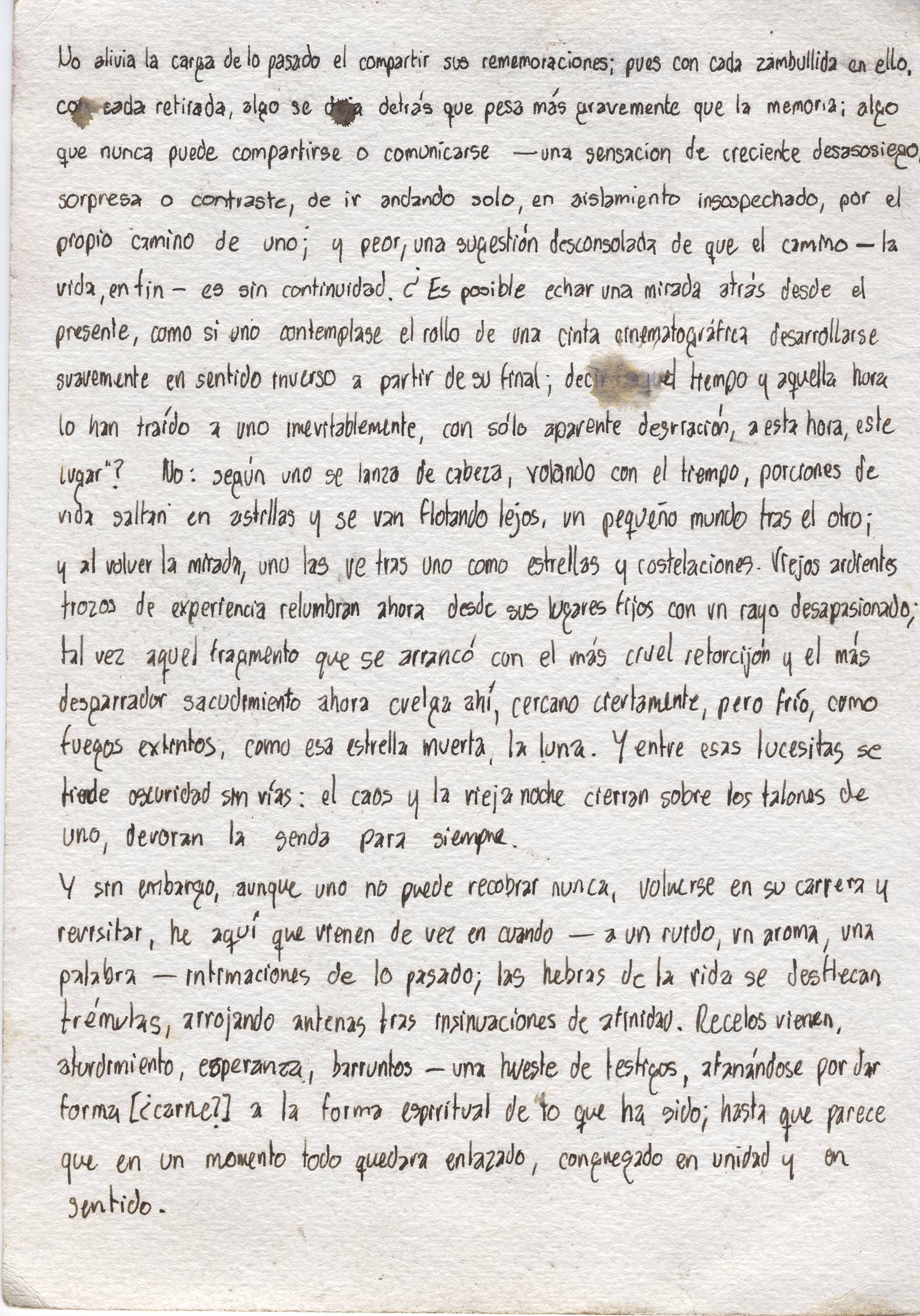
I returned to the academy, perhaps hoping to find maps of the near future, unaware that the encounters that awaited me there would trigger the past. At the moment, the epistemological source of my life, the original source that gives life and meaning, my mother, was born from the cognitive existential field, but not from the body that transits human life. The flesh that lies still warm at my side, uncomfortable and inconvenient, eating and defecating through a primary homeostasis, maintains an inert, almost fixed and empty gaze, from the one who once opened for me the path of birth and thought in language. I have returned to the academy, perhaps thinking of returning the favors I received. Perhaps secretly honoring my mother and her source of inspiration: Guillermo Arcila; who, outlining teachings in the twists and turns of the mind, defined the course of knowledge she would adopt, and therefore, the intellectual openness in which my life would be inserted.
Now, after taking the idea to Manizales, to Arcila’s alma mater, the ideas that the teacher instilled in my mother, which as a child consisted of stories and mythologies, are today foundational texts of my formation as an individual. Both Spinoza’s “Ethics” (especially the third chapter) and Jean Marie Guyau’s “Outlines of a Morality Without Sanction or Obligation” were founding principles of the model my mother instilled in my education. In this revisiting, in this recirculation of knowledge, I sought to reinstate the need to ground the way of life, that is, political life, in these two texts, understanding the passage of time, but not its validity in thought. This line, which for me is related to my being, is epistemologically speaking the desire that drove me to break back into academia. Although the intellectual journey of my life has not been academic, more undisciplined than focused, academia has been my reference world for dialogue or monologue, depending on how I listen. Today, amid corrupt governments and ideological shifts serving capitalism, ruled by the feudal lords of banking, the media, and sugar, public education is mired in a profound crisis in which not even anarchy dares to whisper, drowning its traces in cyanide. Returning to academia, abandoning the attempt to institutionally create the idea of coexistence and peace, becomes a refuge in the mountains from the events unfolding in our streets. Just like the invisible committee’s “The Coming Insurrection,” the voices of students fail to penetrate the bureaucratic walls of the university. The convenience of management remains speaking in the mirror, and open dialogue with the street is blurred by a society that attributes merit to degrees and not titles to merit. The points, commissions, and ranking systems that do not guide my path force me to pause and reflect on the value of ethics in the actions of life.
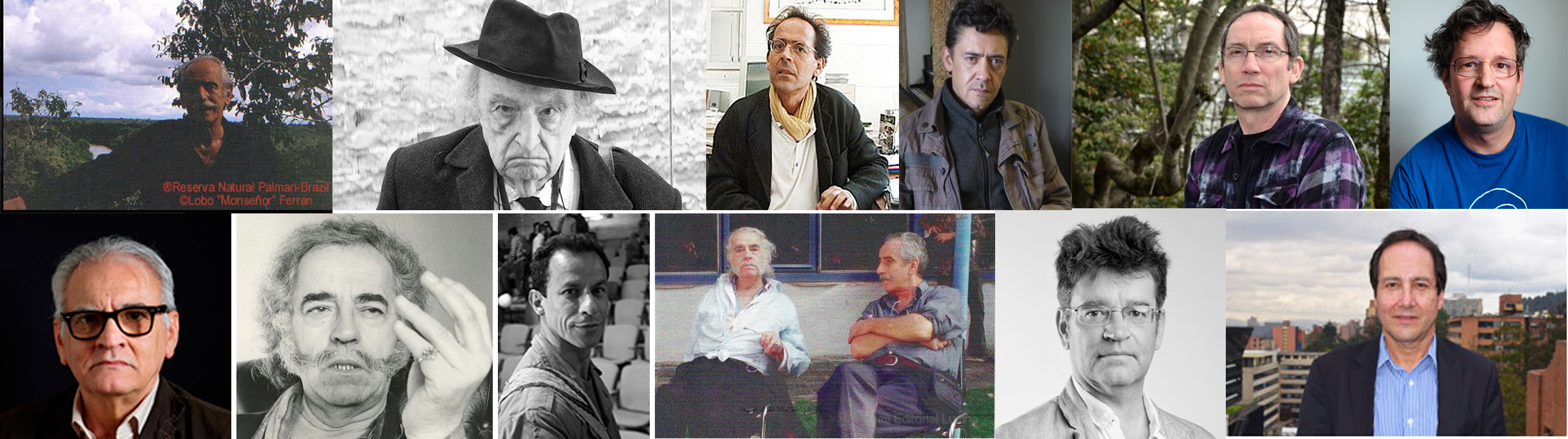
The research he enthusiastically undertook aims to frame the validity of the right life, from the political agency of art and its foundations in the creation of better spaces and worlds. While it sought to explore the limits of art and science through the algorithmic transmission of emotions to the machine, the background was a theological reflection on the inclusion of cognitive artificiality in the migration from the biological neuronal support of knowledge to an inorganic computational support. In this transition of the sign our species is undergoing, the ethical substratum must be the foundation for transmitting ideas and actions. Communicating human emotions through technology will be the last bastion of thinking humanity and will be the destiny of the cognitive future of the social environment that absorbs us. Technology assumes thought logically, normatively between truth and falsehood, without understanding that the logical foundation is an ethical action. We prefer the truth because it is good. We seek goodness in philosophical thinking, questioning the ontological truths of life, without even considering that this approach is an aesthetic gesture. What is admirable, as the master said, is keeping open the mind-world interplay that occurs in consciousness. And the experience, outside the mind, outside of life, occurs in the poetic trace of dwelling. Now, in the academy, after years in which the Wolf’s voice resonated in space, Horta arrives to revalidate the seminal thought of my intellectual journey.
Well, based on this cognitive framework that I frame in the above, action is necessary in response to what has been learned. Namely, the aesthetic framework. The cultural dimension of political action, and in my approach, of artistic practice, are immersed in a dichotomy in our Latin American, Colombian, and Bogotá context. The work of art is in the dichotomy of being presented for the aesthetic enjoyment and contemplation of the viewer, or serving as a critique of reality. If the cultural dimension of the popular has appeared on the walls of the city, it is its expressive and political potential for common life that must lead the visual and aesthetic actions of artistic practices. Art’s ability to reconcile multiple points of view, opening spaces for difference, lies in its power to generate content and information that escapes, even if it permeates, the museums, galleries, and exhibitions of the artistic circle that surrounds us. The intersections of interest occur in the regions of culture that intersect with social resistance, guiding the future of artistic practices. They are what subvert the models of standardization, prescription of uses, and the aesthetic, moral, and economic guidelines that dominate the social construct. Spaces for being in the world are closing for the majority, who, dazed by survival, distract their thoughts with soap operas and soccer; Therefore, art, in our context, must open spaces of well-being for the majority, not for the elites who access art as a consumer good and for aesthetic indulgence. Art demands space for those who want to be heard. Art demands adjustments to social and economic policies, and it is only in art that the poetic action of the ethical action of the right life is outlined.
Understanding the complexity of nonlinear thought, it articulates, in a multidisciplinary way, the efforts to understand the world, the transformative techniques, and the poetics of the human being; it is in Latin American art that the traditional and popular expressions of the core of our people and their cultural dimension survive. Art, as an opening of thought placed in space, is the artistic practice that must be the compass of the times we live in. And while I am currently taking a break from the academy, it is in the work of thought, in the work of art, that I hope to wage war in my poetic dwelling.
While this writing does not intend to frame a research episteme, it does contextualize the seminar within my own research practices. Art must speak from a place. Thought must take a position. In this case, teacher, you explained the procedure of this text by understanding the place and historical moment we are going through, and it is here where you provide the reading and therefore activation. In this sense, the aesthetic plot, or in my case, artistic creation, which in a certain way escapes the episteme of design; establishes the work of art as a creative action in general. It is a previous step to any possibility of enunciative rationalism, and it is the germ of ethical or political action.
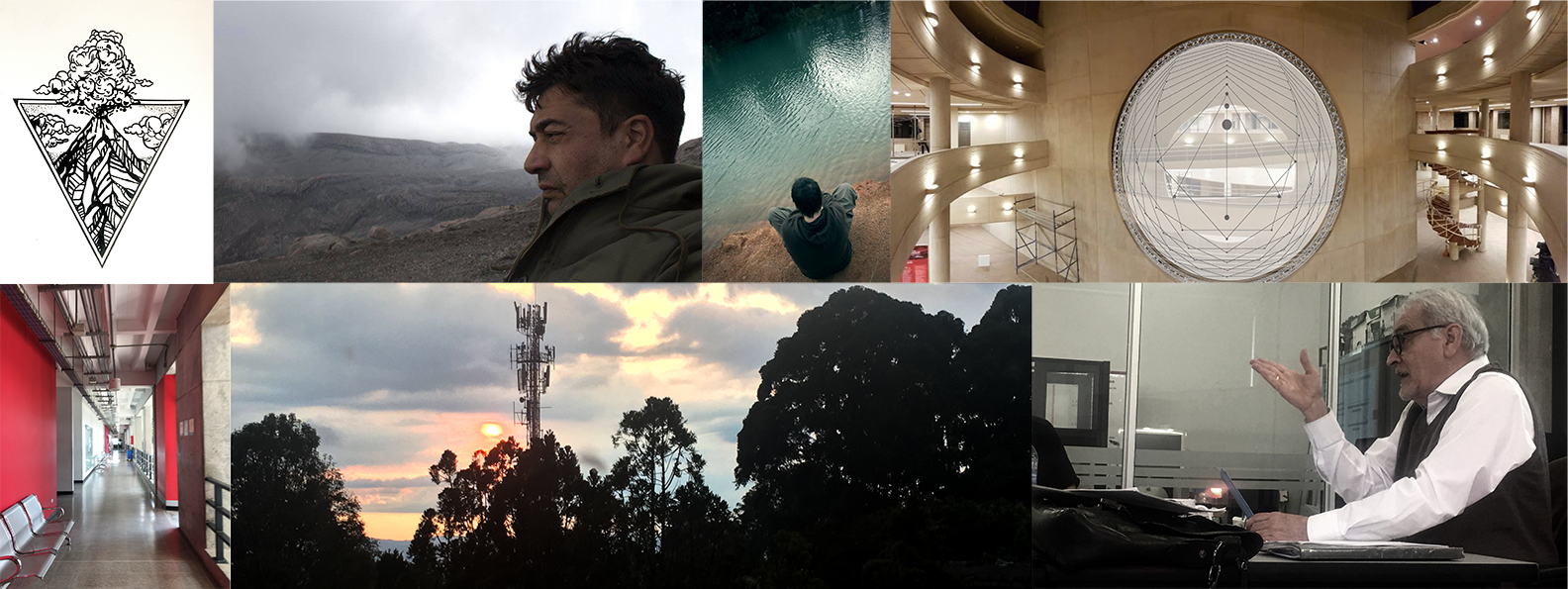
Now, to conclude this short text, I reinforce the idea of poetic dwelling, which I will complement, if you wish, with a text of reflective notes on dwelling and the architectural graphic gesture. In case you’re interested in reading it, I also include a video by Ferran Lobo, who, during the 1990s, instilled this discourse in the aesthetics lectures I attended for a time, which today bring me back to his thoughts at the seminar.
I also want to express my gratitude for your words, redolent of the Caribbean, which revive in me a passion for thought and dialogue. Thank you, and to the eternity of the temporal and evanescent discourse, may this gratitude remain in writing, like a stone that bears witness to the ear in the midst of silence.