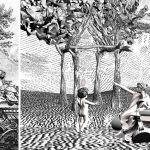


“One morning, this man, frantic or mad, allowed himself to be led to the market. Armed with a lantern in his hands, he kept shouting: ‘I’m looking for God!’ There were many atheists there, and they couldn’t stop laughing. The unbelievers, looking at each other mockingly, asked: ‘Is he lost?’ ‘Has he strayed?’ And they added: ‘Perhaps he went into hiding.’ ‘Or perhaps he’s afraid.’ ‘Perhaps he’s taken a boat or emigrated.’ And the laughter continued. The madman didn’t like this mockery and, rushing in among them, he said: ‘What has become of God?’ Glaring at them, he added: ‘I’ll tell you. We’ve killed him. You and I have killed him. We’ve left this earth without its sun, without its order, without anyone to guide it… Have we emptied the sea? We wander as if through an infinite nothingness.’ And in a questioning and emphatic tone, he went on to affirm that the breath of emptiness touches us, that the night grows darker and deeper, and that it is essential to light lanterns in broad daylight. He stated that the gravediggers are heard burying God, adding that perhaps we must smell the unpleasant stench of divine putrefaction, since, naturally, the gods also rot. And he went on to say that the most sacred and profound has bled to death under our knife, asking, at the same time, if water could be found capable of cleansing the blood of the murderous knife. And he immediately questioned whether the greatness of this act was truly human. And he understood that all posterity was magnified by the magnificence of this act. He became angry and threw his lantern to the ground, and thought he recognized that he had entered among men too prematurely. He sensed that human ears were not yet ready to hear such truths. For lightning, thunder, the light of the stars, and the heroic acts of men take time to arrive. And this last-mentioned act is farther away than the most distant acts. Men know nothing of them, and it is they who have committed the act.
They say that the madman that day entered several churches and intoned a requiem æternam deo. And when he was thrown out, he repeatedly argued: “What are these churches, but tombs and funeral monuments of God?”
Friedrich Nietzsche
“Can a man, when life is all toil,
look up and say: this is how I want to be too? Yes. While kindness still
lies close to the heart, the Pure One, man is not measured
with misfortune
with divinity. Is God unknown?
Is He manifest like the sky? This
is what I rather believe. The measure of man is this.
Full of merit, yet poetically, man dwells
on this earth. But purer
is not the shadow of the night with the stars,
if I could say this, like
man, who calls himself an image of divinity.
Is there a measure on earth? There is none.”
Friedrich Hölderlin
Creation has revolved around the concept of inclement weather. Through meteors (meteorological phenomena), I approach the celestial. Through clouds, rain, thunder, and even storms, I approach atmospheric phenomena to conduct an analogous search for divine signs.
“The sky is the march of the sun. The course of the moon. The brilliance of the stars, the seasons of the year, the light and twilight of the day. The darkness and clarity of the night. The goodness and inclemency of weather. The passing of clouds and the blue depths of the ether.”
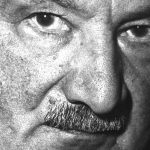
Martin Heidegger
The atmosphere is a familiar place for me. Not only in my past as an aviator, but as a reference point. Contemplating the cloudscape, gazing at the night skies, or being moved by atmospheric phenomena are constitutive of my being. In this, I contemplate beauty, and within me there is a central question about existence itself. Like everyone else. But without the intervention of routine, my art uses these phenomena as a visual material.
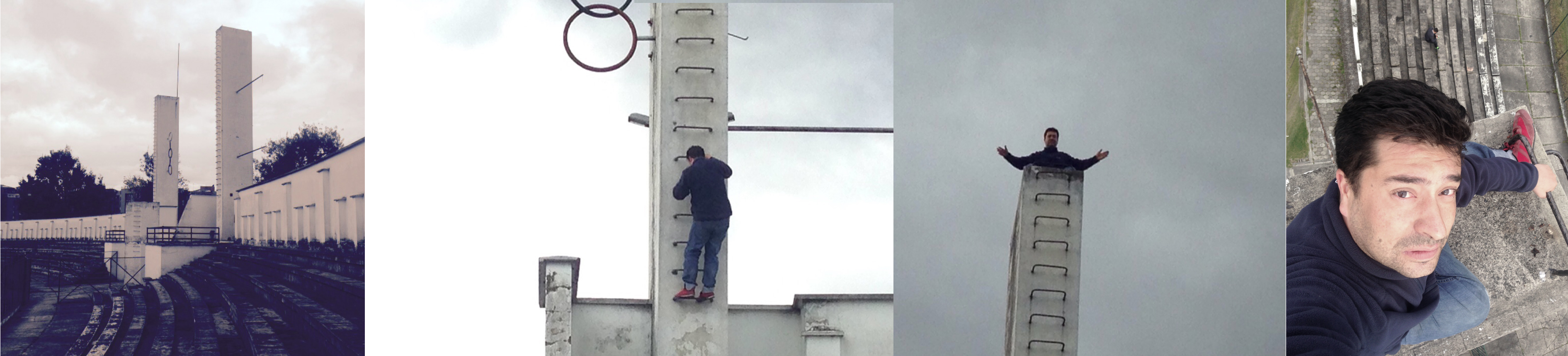
The state of the cloud, the clarity of the rain, or the flash of lightning are reproduced within the architectural space. Atmospheric phenomena are domesticated through science. With science, the content of truth that was the pillar of religion is also displaced, and the hypothesis becomes a certainty refuted over time. Science displaces God from his place in temples.
Yet why does wonder at the sublime in Nature remain? Why do these phenomena confront us in our consciousness with the smallness of human existence and the ephemeral nature of our lives?
Perhaps they are the veils where the divine is hidden.
Gravity
The law of gravity. The first thing to happen after the Big Bang. The attraction between things, between bodies. The attraction to the earth that prevents us from escaping. The curse of Icarus. Since I was a child, I have always perceived gravity as an opposing force. Like the impossibility of flying. My recurring dreams were about flying. I flew freely until it turned into a nightmare when I couldn’t land.
I looked at the skies, the planets, and dreamed of journeys, of freeing myself from my body and traveling. Unfolding myself was another way of resorting to travel. I don’t know if in spirit or in imagination, but I traveled to distant planets and solar systems. The emptiness of infinite space didn’t scare me; on the contrary, it gave me peace.
Floating in the void, or constantly falling into the void, was the sensation that accompanied the nights. I fell for so long that I thought of myself as a meteorite. I left a trail of fire behind me. Fire walks with me.
Stillness
Perhaps thinking, as in Horacio Quiroga’s stories, that human time becomes evident in the instant before death, perhaps thinking that this instant is the moment of understanding existence and experiencing life and death in a final breath of consciousness. It is the element where I would like to explore meditation on death, and on the place God occupies in the emptiness of my existence.
It is hanging, inert, disembodied, where silence converges with stillness and a transcendental meditation on the themes surrounding my work, my question, is manifested.
Time, the instant, and stillness will be the starting point for reflecting on the escape velocity of gravity, on life and the wonder of consciousness. It is here in this inert space where the reflection on the time of life takes place.
Hanging. Unhinged.