
ARTEFACTUM –
Co-creation laboratory in plastic and visual arts.
Artefactum was born for us as an invitation to connect based on who we are: artists, neighbors, collectives, and citizens who inhabit Bogotá with our questions, our memories, and our work. Within the framework of Barrios Vivos (Living Neighborhoods), this project became a space where differences didn’t separate us, but rather opened up possibilities for imagining together. In each workshop, we shared knowledge, experimented fearlessly, listened to the communities, and discovered new ways of creating through co-creation and dialogue. More than a cultural initiative, Artefactum was a community experience: a place where art became a bridge, a driving force, and a starting point for envisioning other ways to transform the city from within.
Oh Fortuna: Semiotics of Promise and Chance
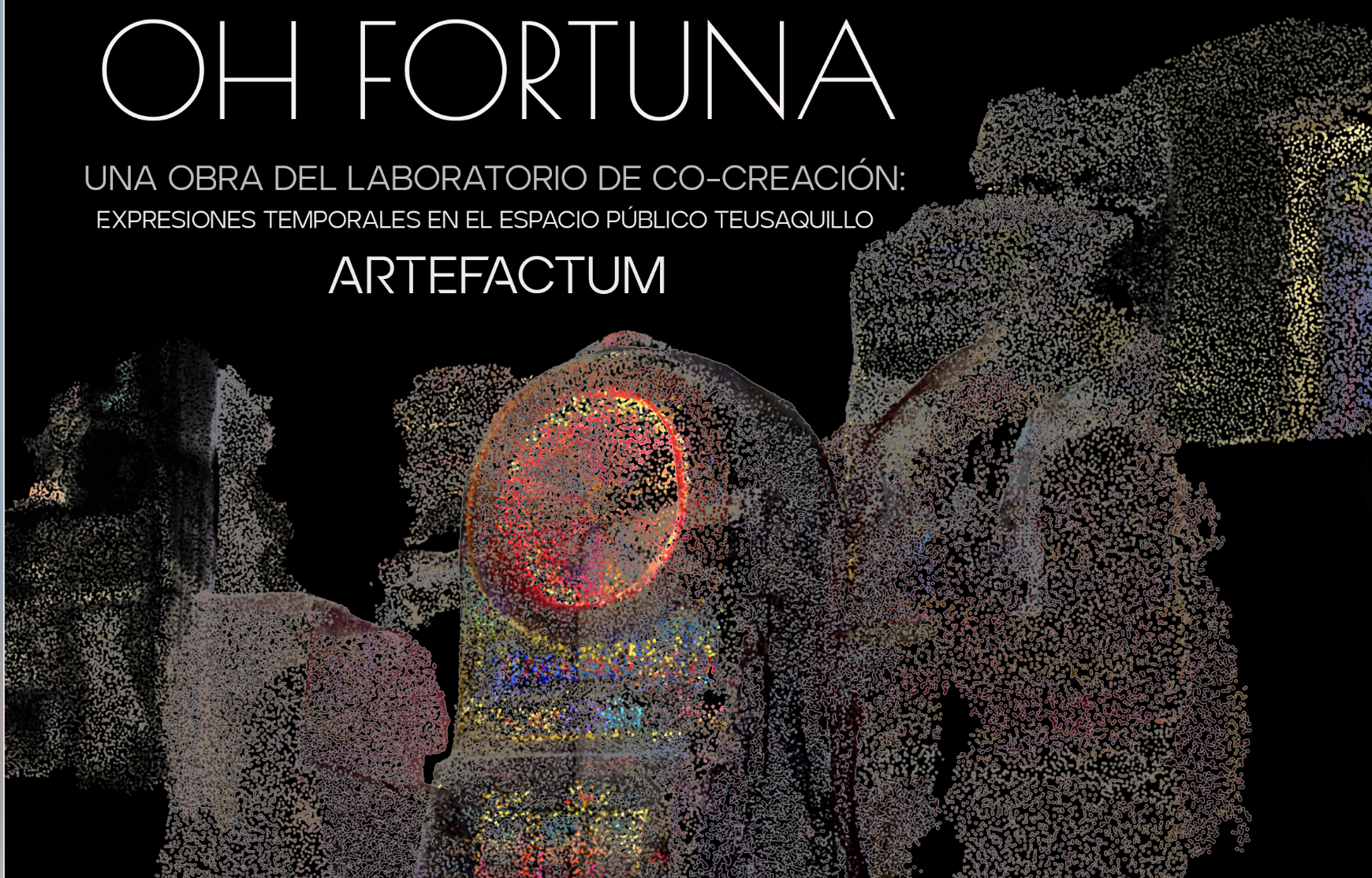
The installation Oh Fortuna, developed by the ARTEFACTUM Workshop collective within the framework of IDARTES, is a traveling work that roams Bogotá like a contemporary machine of destiny: three slot machines, plastically altered, that transform civic faith, urban progress, and intimate promises into a grammar of chance. The project rests on a thesis that resonates with the notion of the Royal Casino in contemporary thought: in the algorithmic age, chance no longer belongs to the realm of chaos, but to the logic of control. The political, financial, and affective system is configured as a network of programmed bets, where every action—voting, going into debt, loving—functions as a play in a casino that needs us to keep believing that one day we will win.
The machine, as metaphor and structure, does not promise fortune, but recognition. Each spin reveals the hidden programming of the modern promise: the illusion of choice that conceals a predetermined outcome.
The Nation-State Machine: The Roulette of Empty Identity
Here, the broken promise is expressed in patriotic iconography, reconstructed from an archaeological reading of the national symbol. The condor, the cornucopias, the flag, and the Phrygian cap—legacies of enlightened republicanism—spinning alongside new insurgent emblems: the Wiphala, fallen statues, and fragments of memory.
The alignment of official symbols is the “loss”: the mechanical repetition of a meaningless identity. The alignment of contested symbols is the “prize”: the irruption of an active memory that deprograms the national narrative.
The nation appears as a roulette wheel of meanings spinning aimlessly, a system where history is recycled to maintain faith in the promise of unity.
The Infrastructure Machine: The Broken Promise as Ruin
The second machine translates the discourse of progress into the language of ruin. The icons—the White Elephant, the unfinished Metro, the Cage House of credit, the financial Ouroboros—form the trilogy of perpetual debt.
In contrast, the infrastructures of hope appear: the community kitchen, the community kitchen, the Indigenous guard. Winning here is not about achieving wealth, but about recognizing that true social infrastructure is not built with cement, but with cooperation.
In the golden machine of debt, the city becomes an urban casino: the citizen continues to gamble time, work, and faith on a future that never arrives.
The Machine of the Everyday: Empty Language
The third machine brings ruin to language.
The small promises—”I’ll call you,” “see you,” “I love you”—revolve endlessly in a choreography of devalued affections. The systemic failure of the State produces a semiotic crisis: the sign is separated from its meaning, the word loses weight, and the promise becomes a performative formula that maintains the appearance of the bond.
Love, money, and health become gambles: with each spin, everyday faith reproduces the logic of the algorithm. The personal promise is a reflection of the state’s promise: both operate under the illusion of reciprocity, but in reality, they only sustain the cycle of the game.
The Semiotic Process: Prizes, Losses, and Recognition
The design of O Fortuna is organized as a system of rotating signs, where each machine represents a level of promise (symbolic, material, linguistic). The “prizes” and “losses” are not random results, but rather structures of meaning that reveal how power operates:
• Losing is reproducing the illusion of the system.
• Winning is recognizing the artifice and seeing the mechanism.
The act of inserting a coin does not activate a machine, but an allegory of the present: the economy of desire, where faith becomes capital and hope becomes political fuel.
“These machines do not simulate chance: they manage it.”
In O Fortuna, art does not seek to disrupt the program, but to expose it.

Felipe Sanclemente
The Mechanics of Disenchantment and the Architecture of Chance
In the dense urban fabric of Bogotá, where modernity and ruin coexist in perpetual tension, a new artifact of political and poetic intervention is erected, intended to disrupt the pedestrian flow of the Teusaquillo district. Entitled O Fortuna, this installation is not merely a static work of art, but a radical sociological diagnostic device that redefines the Colombian experience through the operational logic of the slot machine. Far from a superficial aesthetic appropriation of casino culture, the piece puts forward a devastating thesis: the fundamental structure governing the Colombian nation-state, its infrastructural development, and the affective intimacy of its citizens is not democracy, urban planning, or romantic love, but a manipulated game of chance.
The installation, composed of three interactive machines, breaks down the phenomenology of the “broken promise” into three geological strata of national disappointment: the macro-political (The Nation), the meso-structural (The Infrastructure), and the micro-social (The Everyday). By inviting the viewer to insert a coin—described in the curatorial text as a “gesture of trust” and a “minimal faith”—the work initiates a mechanical cycle that mimics the physiological and psychological loops of hope and frustration that characterize the national psyche. The theoretical premise of O Fortuna suggests that patriotic symbols, blueprints of urban progress, and vows of interpersonal love have been emptied of their referential weight, reduced to rotating icons in a system designed to manage an “illusion of choice” that conceals the predetermined design of the outcome.
This research report offers a comprehensive and nuanced analysis of the O Fortuna proposal, situated within the co-creation methodologies of the ARTEFACTUM laboratory, deconstructing its semiotic conceptual rigidity and mapping its socio-spatial implications. The analysis traces the work’s trajectory from its institutional legitimization at the Centro Felicidad (CEFE) Chapinero to its insertion into the contested public spaces of Teusaquillo. Through the lens of Walter Benjamin’s critical theory of Parisian arcades, Natasha Dow Schüll’s anthropology of addiction, and the historical genealogy of Colombian symbolism, it is argued that O Fortuna functions as a “counter-monument” to the operative fatalism of the postcolonial state.
The Laboratory of the Social:
ARTEFACTUM and the Politics of Co-Creation
To understand the conceptual density of O Fortuna, it is imperative to first examine its genesis within the ARTEFACTUM Laboratories of Co-creation and Social Innovation, an initiative of the District Institute of the Arts (IDARTES) that marks a paradigm shift in the production of public art in Bogotá. This model moves away from the figure of the vertical “artist genius” to embrace a polyphonic and horizontal construction of meaning, where citizens are not only spectators but also co-authors of the symbolic narrative.
The Hive Methodology: Risk, Error, and Situated Experimentation
The ARTEFACTUM laboratories are conceived as “territories to try, fail, and attempt to change,” prioritizing the creative process over the final product. This methodology is crucial to the ontology of O Fortuna, since the work does not seek to impose an authoritarian and singular vision of the country, but rather incorporates the collective frustrations and desires of the community. The methodology is “situated,” adapting to the specific context of the territory—in this case, the urban tensions of Teusaquillo and Chapinero—and recognizing the creative potential of each participant, dissolving the hierarchies between professional artists and ordinary citizens.
The result is a collective precipitate of the social psyche. The choice of the slot machine as a medium is not accidental; it arises from a dialogue between co-creators who identify that life in Bogotá feels governed by an algorithm of high effort and random, often punitive, reward. The “uncertainty” that ARTEFACTUM defends as a constitutive part of the creative process is ironically reflected in the work itself, which uses the mechanics of uncertainty (the game of chance) to critique the precariousness of life. The laboratory functions as a space for experimentation where error is not an obstacle, but a fundamental creative component, allowing the installation to explore the flaws of the system without fear of immediate institutional censorship.
The Transition to Circulation: From Incubator to Public Space
The circulation phase, scheduled for November and December 2025, marks the critical transition from the safe haven of the laboratory to the public sphere. The deployment of O Fortuna aligns with IDARTES’ broader strategy of using the “Artefactum” brand to intervene in the city’s cultural metabolism, placing these co-created objects in high-visibility settings such as CEFE Chapinero and the Cinemateca. This institutional legitimization grants the installation a layer of protection that allows it to offer a subversive critique of the very state structures that fund it—an inherent and productive tension in contemporary public art.
The Semiotic Engine:
A Tripartite Deconstruction of the National Bet
The conceptual rigidity of O Fortuna rests on a strict semiotic alignment through its three constituent machines. The proposal draws elements from a deep well of Colombian iconography, historical trauma, and contemporary unease, organizing them into endlessly rotating “reels.” Analysis of the provided documentation reveals a complex palimpsest of identity, which the installation mechanically animates, transforming history into a probabilistic combinatorics.
Machine I:
The Nation-State (The Broken Fortune of Identity)
The first machine addresses the symbolic construction of identity, functioning as a critique of the historical narrative that defines “Colombianness.” The documentation suggests that Colombian identity is a battleground of symbols, continually rewritten, but never completely erased. The slot machine format is particularly effective here, as it treats historical symbols not as fixed and sacred truths, but as tokens of exchangeable value in a market of political legitimacy.
The document Colombian Symbolism highlights the pre-Columbian Muisca representation, which depicts cosmic movement and the correspondence “as above, so below,” symbolizing evolution and the cycles of the Milky Way. In the slot machine, the spiral—once a symbol like Bachué and Bochica—is reduced to the mechanical, rotating motion of the reel. The sacred, cyclical time of the Muisca is secularized and degraded into the repetitive and addictive time of the compulsive gambler.
Similarly, the frog, a fundamental symbol of fertility, water, and the origin of the game of Tejo (Turmequé), appears as an icon of potential winnings. The irony is structural: Tejo is an ancestral game of skill, gunpowder, and community, declared Intangible Cultural Heritage; the slot machine is the modern game of passive consumption and isolation. By placing the frog on the reel, the installation laments the loss of active Indigenous cosmogony in the face of passive capitalist chance. The Muisca goldwork, the tunjos, which were sacred offerings, become here the currency that feeds the machine, desacralizing the offering into a commercial transaction.
The machine interrogates the “iconography of fear and salvation” imposed during the Conquest; the syncretic virgins function as “wild cards” in this national game. Historical analysis indicates that religious images were used as a “linguistic bridge” for evangelization and control. In O Fortuna, these images revert to their original function of biopolitical control: they promise salvation (a victory in the game) while demanding submission (the ongoing wager). Syncretism, which was a form of resistance where the indigenous survived camouflaged, is presented here as a confusion of identities, a “salad” of signifiers spinning too fast to be decoded.
The most scathing critique is reserved for republican symbols. The Phrygian cap, a universal symbol of liberty imported from the French Revolution and placed on a lance on the national coat of arms, spins alongside cornucopias (horns of plenty). The installation renders these emblems of Law 3 of 1834 absurd. The cornucopias, meant to shower gold and fruit upon the nation, are trapped behind the glass of a machine that only receives money and rarely gives it back.
The Isthmus of Panama, present on the coat of arms as a “phantom wound” or “lost limb” of the nation, serves as the symbol of the “Near Miss” in gambling psychology. In slot machine design, the “near miss” (seeing the prize symbol just above or below the payline) is designed to activate the same reward areas in the brain as an actual win, encouraging continued play. Panama is the jackpot that Colombia almost held onto but lost, fueling a national nostalgia that drives the compulsion to keep playing politics to “recapture” lost greatness.