

Loneliness is probably one of humankind’s oldest fears. It has always been there, and since our origins we have fought against it by moving in groups or gangs and looking out for one another, until we depart. Perhaps death, the other most archaic fear, also has something to do with this fear of loneliness, as Bécquer himself tried to put words to this desolation with the famous phrase, “how alone the dead remain.” There is one animal in the world that, however, holds the title of being the loneliest due to its sad story. It is the 52-hertz whale, also known as the ‘lone whale’ or ‘Whalien 52’. It was discovered in 1989, and since then it has been detected in various locations around the globe. In the 1960s, two American biologists discovered that male humpback whales produce something like repetitive songs to communicate with other members of their species.
Their song pattern isn’t similar to that of other whales; instead, their songs are much higher-pitched, shorter, and more frequent.
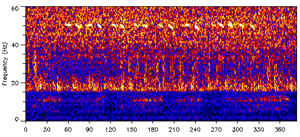
Since then, experts have continued studying the language of these mammals, and it’s now known that the sounds they emit fall within a frequency range of 15 to 25 hertz. The problem? The 52-hertz whale, as its name suggests, sings at an unusual frequency, much higher compared to other species.
It doesn’t have a pattern similar to that of blue whales (between 10 and 39 hertz) or fin whales (around 20 hertz); instead, its songs are much higher-pitched, shorter, and more frequent. To this day, the precise physiological mechanism behind these songs remains unknown. For example, baleen whales have a larynx but no vocal cords, and they don’t need to exhale to produce these curious sounds.
The 52-hertz whale has yet to be found. Since 1992, researchers at the Woods Hole Oceanographic Institution have been trying to record its song, as well as its migratory movements across the North Pacific. They did so for 12 years with the help of the Sound Surveillance System (SOSUS), a surveillance system created by the U.S. Navy during the Cold War to detect Russian submarines. With the fall of the Iron Curtain, however, SOSUS was declassified by the government.
It’s a male, because males are the ones who produce complex songs to attract females and mate.
The conclusion, from a theoretical point of view, given the inability to identify the species, is that it’s a male, because males are the ones who produce complex songs to attract females and mate. Furthermore, years of monitoring have shown that its migration routes coincide with those of other whales. Several possibilities exist: it could be a blue whale suffering from some kind of malformation, a hybrid between two species, the last member of an extinct family, or even a deaf whale that never learned to produce sounds at the appropriate frequencies.
Whatever the case, popular culture has tried to humanize the whale, not only by giving it the nickname ‘the loneliest whale in the world,’ but also through songs (Chrysta Bell, the Korean group BTS), short films like ‘The Loneliest’ (2014), and even books like ‘A 52-Hertz Whale’ by Bill Sommer. We can’t really know for sure whether it can’t reproduce or if the other whales truly don’t hear it, as they might (even though its song sounds strange to them). But the story of this sad whale, who travels the world alone simply because no other whale can hear it, has remained in the collective imagination, filled with empathy. Perhaps one day its message will be deciphered.